Same-Day Emergency Dental Appointments
We offer same-day relief for urgent dental issues like tooth pain or broken, cracked, or chipped teeth. Call now to be seen right away!
You need a bone graft for dental implants only if your jaw does not have enough healthy bone to support the implant in the right position. Many people can move forward with dental implants without grafting, while others need a small graft at the time of extraction or a larger graft before implant placement. The safest way to know is with an exam and 3D imaging.
If you're weighing whether bone grafting is required to support a future dental implant, a focused implant evaluation clarifies your options and whether staged treatment is necessary. At Smileology in Niceville, FL, our team reviews scans, explains grafting versus implant approaches, and outlines expected timelines and benefits.
A dental implant acts like an artificial tooth root, so it needs enough surrounding bone to stay stable during healing and daily chewing. After tooth loss, the jawbone often shrinks because it no longer receives stimulation from the natural root. Some of the most noticeable changes can happen in the first year, especially with missing tooth bone loss.
Bone loss can also happen because of gum disease, infection, injury, long-term denture use, or naturally thin jaw anatomy. In the upper back jaw, the sinus may leave too little bone height for an implant even when the gums look healthy.
A bone graft creates a scaffold that helps the body build and maintain bone in the area. A graft does not guarantee implant success, but it can create safer dimensions for proper placement and long-term function.
In some cases, early planning after an extraction may reduce how much grafting is needed later. If you want to understand ways of slowing bone loss, that discussion is worth having before or right after a tooth is removed.
Dentists do not decide this based on the gums alone. They evaluate bone width, height, density, and shape, along with the position of nearby nerves and sinuses.
A cone-beam computed tomography scan, or CBCT scan, gives a three-dimensional view of the area. For implant planning, CBCT is widely considered the imaging tool of choice for three-dimensional site assessment. Some practices also use digital planning and guided systems such as YOMI robotic surgery to map ideal implant position before surgery.
The scan also helps the dentist plan for the final crown, not just the implant itself. If an implant can only be placed where leftover bone happens to remain, the tooth may come out at a poor angle. In that situation, grafting may improve both function and appearance.
You may be more likely to need grafting if:
A thin ridge does not always mean you need a separate grafting surgery. Depending on the anatomy, your dentist may recommend a narrower implant, a small graft at the same visit, or a different type of restoration.
The right approach depends on how much bone is missing and where the defect is located. Graft material may come from processed donor bone, animal-derived material, a synthetic source, or, less commonly, your own bone.
|
Treatment Approach |
When It May Be Considered |
Typical Implant Timing |
|---|---|---|
|
No graft |
Enough healthy bone surrounds the planned implant |
Implant can often be placed directly |
|
Socket preservation |
A tooth is removed and future bone volume should be protected |
Often after several months of healing |
|
Minor graft with implant |
A small defect can be treated while the implant remains stable |
Graft and implant at the same visit |
|
Ridge augmentation |
The jaw is too narrow or has a larger defect |
Implant usually follows graft healing |
|
Sinus augmentation |
The upper back jaw lacks enough bone below the sinus |
Same-day or delayed placement, depending on available bone |
Socket preservation places graft material into the extraction site to reduce collapse during healing. It cannot stop all bone changes, but it may make future implant treatment easier.
Ridge augmentation rebuilds lost width or height. Sinus augmentation creates space for bone under the sinus lining when the upper back jaw is too thin for an implant.
Larger defects may require staged treatment or referral for oral surgery. The goal is not just to add bone, but to create a stable foundation for the final restoration.
Candidacy depends on more than bone volume. Your dentist also looks at gum health, active infection, bite forces, oral hygiene, smoking or nicotine use, medical history, and healing ability.
Uncontrolled diabetes, untreated gum disease, heavy nicotine use, and certain medications can increase the risk of complications. These factors do not always rule out treatment, but they do affect timing and planning.
Some patients can avoid grafting with a different implant design or a different treatment plan. In other cases, skipping a graft may place the implant in a poor position or reduce long-term predictability.
Alternatives may include a fixed bridge, a removable partial denture, or a complete denture. If you want a broader look at tradeoffs, see dental implants pros and cons.
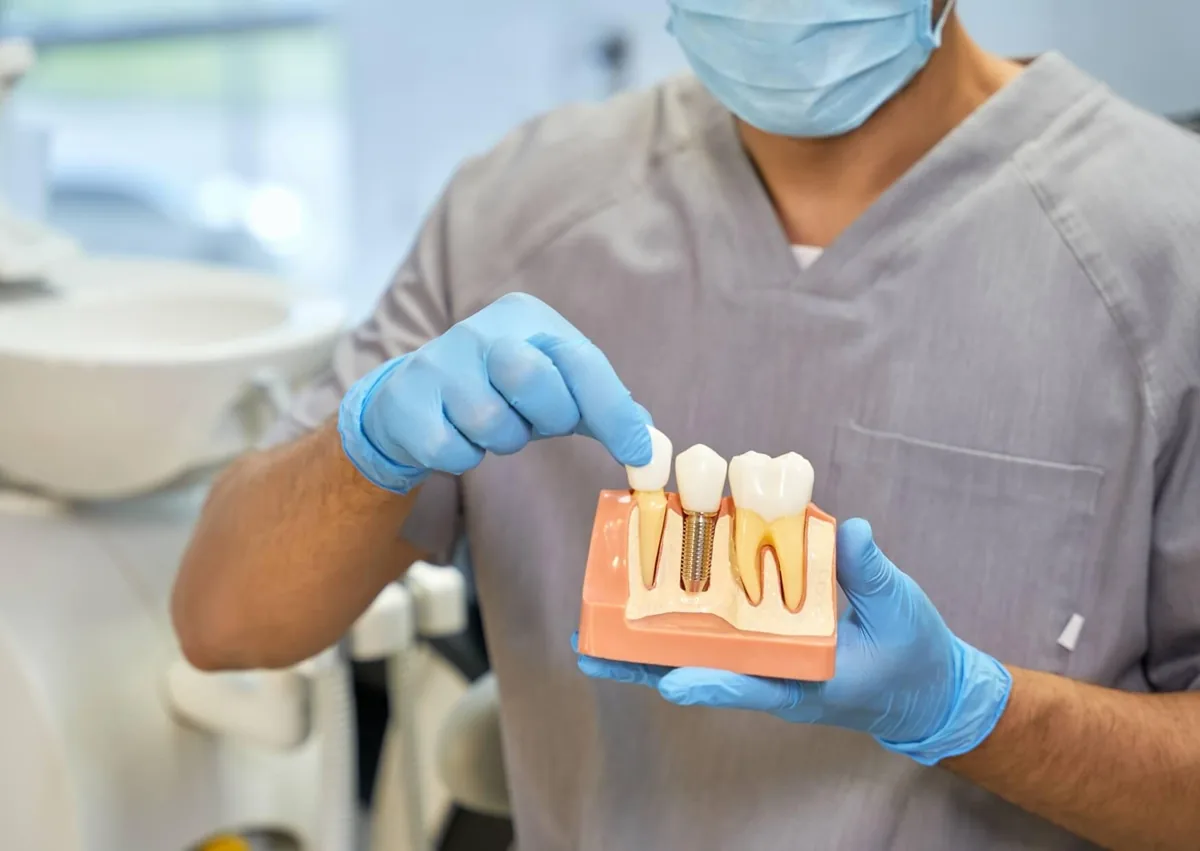
Treatment usually starts with an exam, imaging, and a plan for the final tooth replacement. Any active infection or uncontrolled gum disease usually needs to be treated before or during the surgical phase.
After a graft is placed, the area is protected while new bone develops. Healing often takes several months, and some grafts may take four to six months to heal. The exact timeline depends on the graft size, location, your health, and whether the implant was placed at the same visit.
Once healing is confirmed, the implant may be placed and allowed to integrate with the bone. The final crown, bridge, or denture attachment is added after the implant reaches enough stability, so staged cases can take many months from extraction to final restoration.
Follow your surgical instructions closely. Avoid pressing on the site, pulling at the area, or repeatedly checking it, because early disturbance can interfere with healing.
A successful graft may make implant placement possible, improve implant positioning, and support gum contours around the final tooth. In visible areas, that can help the restoration look more natural.
Bone grafts and implants still have limits. Complications can include infection, graft exposure, graft loss, sinus problems, nerve injury, poor integration, or inflammation around the implant.
Long-term care includes brushing, cleaning around the implant as directed, regular professional maintenance, and follow-up imaging when needed. People with a history of gum disease or nicotine use may need closer monitoring because implants can still lose supporting bone over time.
If possible, schedule an implant evaluation before a badly damaged tooth is removed. The extraction plan can affect how much bone is preserved and whether grafting is recommended at the same time.
If the tooth is already missing, earlier evaluation is still helpful. Bone changes can become more significant with time, which may limit options or increase the amount of treatment needed.
Call a dentist promptly if you have worsening pain, increasing swelling, pus, a bad taste, persistent bleeding, fever, or exposed graft material. Trouble breathing, trouble swallowing, or rapidly spreading swelling needs urgent medical attention.
A consultation can show whether you have enough bone now, whether grafting can be done with implant placement, and what alternatives fit your health and goals. If you need help choosing a provider, learn how to choose a dental practice.
Discussing your scan and grafting options with a clinician is the best next step to confirm whether implants can be placed now or after staged grafting. Contact Smileology for dental implants in Niceville, FL and nearby Miramar Beach, FL. Call (850) 897-4488 to arrange a consultation or learn about same-day availability.
Yes. If imaging shows enough healthy bone to support an implant in the correct position, grafting may not be necessary.
Sometimes. This may be appropriate when the defect is small and the implant can achieve strong initial stability. Larger defects usually require graft healing first.
The procedure is done with local anesthesia, and sedation dentistry may be available when appropriate. Temporary soreness, swelling, and bruising are common, but severe or worsening symptoms should be reported promptly.
Many grafts need several months of healing before implant placement. The exact timing depends on the procedure, graft size, location, and how much new bone forms during healing.
Coverage varies by plan and by the reason for treatment. Ask for a written estimate and check both dental and medical benefits, since exclusions, waiting periods, and annual limits may apply. For pricing and budgeting details, see cost of dental implants.


We work with most PPO dental plans, including Aetna, MetLife, Guardian, United Concordia, UnitedHealthcare, and Cigna. In-network status depends on your employer plan. Delta Dental plans are handled on an out-of-network basis; contact us to review your benefits.